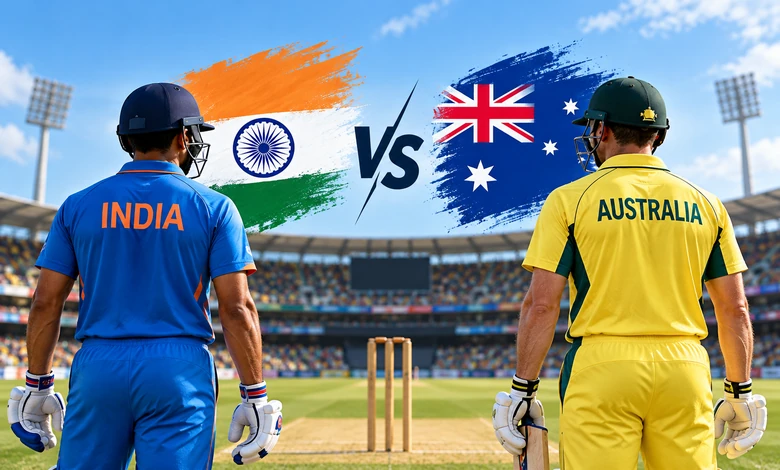
India and Australia have produced one of cricket’s most closely followed international rivalries, with their contests stretching from the first Test in 1947 to modern multi-format series and major ICC events. As of 8 November 2025, Australia held the overall advantage across men’s Tests, ODIs and T20Is, with 146 wins to India’s 114 in 304 meetings. India, however, had the stronger record in T20 internationals, showing why format-by-format context matters when reading this rivalry.
India vs Australia overall head-to-head record
The overall numbers illustrate both Australia’s historic advantage and the depth of the contest. The teams had played 112 Tests, 155 ODIs and 37 T20Is by 8 November 2025. Australia led in the two longer-established formats, while India led clearly in T20Is. There had also been 44 matches across formats that ended in a draw or no result.
| Format | Matches | India wins | Australia wins | Draw/No result |
| Tests | 112 | 33 | 48 | 31 |
| ODIs | 155 | 59 | 86 | 10 |
| T20Is | 37 | 22 | 12 | 3 |
| Total | 304 | 114 | 146 | 44 |
These figures cover men’s internationals between the two sides through 8 November 2025. They should not be treated as a guide to any one upcoming fixture on their own. Team selection, venue, pitch conditions, match format and player availability can all alter the balance considerably. The popularity of searches such as today match prediction 100 sure reflects the interest around individual fixtures, but a broad head-to-head record is only one part of meaningful pre-match analysis.
Test record: Australia’s long-term edge
India and Australia first met in a Test from 28 November to 4 December 1947. Australia won that inaugural encounter by an innings and 226 runs, beginning a rivalry that would develop greatly over later decades. By January 2025, the teams had contested 112 Tests: Australia won 48, India won 33, and 31 were drawn.
The Test numbers reflect the format’s long history and the importance of home conditions. Australia’s overall lead came from a larger total of wins, but India’s 33 victories show that the contest has been far from one-sided. Draws also remain significant in the Test record, accounting for 31 of the 112 matches, underlining how five-day cricket produces outcomes that cannot be understood simply through wins and losses.
The latest Test meeting listed in the record came from 3 to 5 January 2025, when Australia won by six wickets. The next Test meeting was listed for 21 January 2027. Between those dates, the existing aggregate remains a historical summary rather than evidence of current form. A Test series can be shaped by factors such as the new ball, batting depth, workload management and how teams adapt across several matches.
World Test Championship final
One of the rivalry’s major Test occasions was the 2023 ICC World Test Championship final. Australia won that match by 208 runs, adding a high-profile neutral-venue result to their overall Test advantage. The final was the only World Test Championship final contested by India and Australia in the head-to-head record through November 2025.




That match also demonstrates why tournament fixtures occupy a distinct place in the rivalry. A bilateral series allows teams time to recover from a setback and make tactical changes, while a final is a single decisive contest. Both types of match contribute to the head-to-head ledger, but their pressure and context are very different.
ODI record: Australia lead the largest format sample
ODIs provide the largest sample of India-Australia meetings. The teams had played 155 men’s ODIs by 25 October 2025, with Australia winning 86 and India 59. Ten matches ended without a result, while no tied matches were recorded in the aggregate.
The home, away and neutral breakdown adds useful detail. India had 33 home ODI wins, 15 away wins and 11 neutral-venue wins against Australia. Australia had 40 home wins, 34 away wins and 12 neutral-venue wins. Australia’s away total is particularly notable because it indicates that their overall ODI lead was not based only on performances at home.
The final ODI in the listed sequence took place on 25 October 2025. India made 237 for 1 in reply to Australia’s 236 and won by nine wickets. In the same series, Australia won the first ODI by seven wickets under the DLS Method and the second by two wickets. The three results offered a reminder that even a short bilateral series can contain sharply contrasting match situations.
World Cup meetings
Australia’s advantage is also visible in men’s Cricket World Cup encounters. The teams had met 14 times in the tournament, with Australia winning nine matches and India five. Among the defining results were Australia’s 125-run victory in the 2003 final and their six-wicket win in the 2023 final at Ahmedabad.
India also had important World Cup victories. They defeated Australia by five wickets in the 2011 quarter-final and won by six wickets in the 2023 group-stage meeting. These results show why a tournament-specific record deserves separate treatment: Australia led the overall World Cup contest, but India had delivered meaningful wins in knockout and group-stage situations.
T20I record: India’s strongest format against Australia
T20 internationals are the one format in which India held the better overall head-to-head record. In 37 men’s T20Is through 8 November 2025, India won 22 matches and Australia won 12, with three games ending in no result. India’s advantage in this format contrasts with Australia’s leads in Tests and ODIs.
The first T20I between the teams was played on 22 September 2007, when India won by 15 runs. Their latest listed T20I, on 8 November 2025, ended without a result. The smaller number of T20I meetings compared with Tests and ODIs is worth remembering; the format’s record is based on a shorter history between the sides.
India also held an edge in men’s T20 World Cup matches against Australia, winning four of their six meetings. India’s 15-run semi-final victory in the 2007 tournament was among the earliest major T20 clashes between the teams. Australia won the 2010 and 2012 meetings, while India won matches in 2014 and later editions covered by the six-game record.
ICC events and what the numbers reveal
Across major ICC competitions, India and Australia had played 26 matches through 8 November 2025. Australia won 13, India won 12, and one match ended with no result. This near-even overall ICC record differs from Australia’s clearer all-format lead, largely because India’s stronger T20 World Cup and Champions Trophy results narrowed the gap.
In the Champions Trophy, India won three of four matches that produced a result, while one of the five total meetings ended without a result. The World Cup and World Test Championship figures favoured Australia, whereas T20 World Cup results favoured India. The broader lesson is that there is no single India-Australia narrative that applies equally to every format or tournament.
Conclusion
India versus Australia remains a rivalry defined by contrasting records rather than one simple pattern. Australia held the overall, Test and ODI advantages through November 2025, while India led the T20I head-to-head and had strong results in selected ICC competitions. Looking at the format, venue and tournament context alongside the headline totals offers the clearest understanding of this enduring contest.